
Key production numbers
Setup unitEach print colour or special separation may require its own prepared screen.
Planning rangeA straightforward screen setup may be budgeted around USD 20–60 per screen before the per-piece run charge.
Dark garmentsA white underbase can add a screen, print pass and curing requirement.
Scale effectThe same setup is divided across more units when artwork and colour stay unchanged.
What setup includes
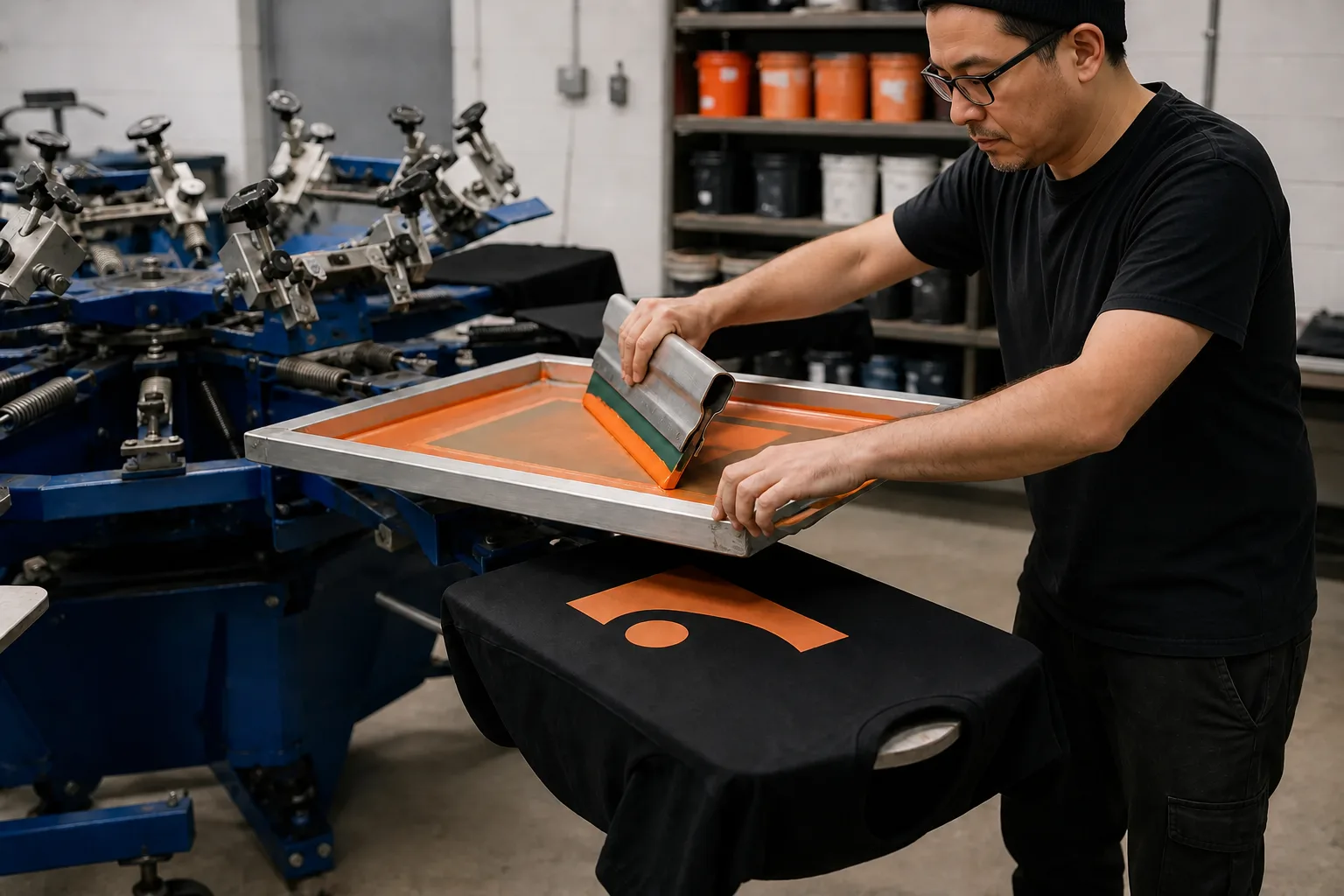
Screen printing uses a stencil on mesh so ink passes only through selected areas. Setup may include artwork separation, film or imaging, screen coating and exposure, registration, ink mixing, press setup and test prints.
The U.S. EPA describes flat screen printing as forcing print paste through a screen with a squeegee. Garment printers apply the same core principle on manual or automatic presses, with operational detail changing by artwork and fabric.
Planning setup and run cost
For early planning, a straightforward garment screen may be budgeted around USD 20–60 per screen, followed by a per-piece print charge. Specialty inks, halftones, exact colour matching, oversized frames or difficult placements can increase both. These are SHENGDE planning estimates.
Request a quote that separates artwork or screen setup from the running price. Also confirm whether screens are stored, reclaimed or charged again on repeat orders.
Colour count is not the whole story
A dark garment often needs an underbase beneath the visible colours. Halftones and simulated process artwork may need additional separations, while specialty effects such as puff or high density require compatible screens and curing.
Send vector or high-resolution artwork and identify garment colours. The printer should explain the production separation rather than quote from the visible number of colours alone.
Fabric and curing matter
Cotton, blends, polyester and coated fabrics can require different ink systems, pretreatment or temperature controls. Dye migration, scorching, poor adhesion and heavy hand feel are production risks.
Approve the actual garment and test the intended care process. A screen test on white cotton does not prove the same colour or durability on black polyester fleece.
How quantity changes unit economics
The preparation work is similar whether 30 or 300 pieces are printed, so setup contributes more per unit in a short run. Multiple garment colours can also require ink or underbase adjustments.
For a small launch, reduce placements or keep one artwork across colourways. Preserve the approved screens or separation files when repeat orders are likely.
Comparable quotation checklist
Provide artwork, finished size, placement, garment style and colours, fabric composition, quantity by colour and size, target colour reference and performance expectation.
Compare screens, sample, running charge, rejects, curing, folding, screen storage and repeat setup. The lowest print-only number may exclude necessary control steps.
Screen printing quote structure
| Item | What to confirm | Cost risk |
|---|---|---|
| Artwork | Vector file and separations | Rework for low-resolution art |
| Screens | Count including underbase | Extra colours or specialty mesh |
| Ink | Type and colour match | Specialty or migration block |
| Garment | Fabric and colour | Pretreatment or temperature limits |
| Run | Quantity per design | Short runs carry more setup per unit |
| Repeat | Screen/file retention | New setup after reclamation |
Frequently asked questions
Does every colour need a screen?
Often yes, while underbases and special separations may add screens beyond visible colours.
Why do dark shirts cost more?
They commonly require an underbase and additional print and curing steps.
Are screens kept for repeat orders?
Policies vary; confirm storage time, ownership and repeat charges.
Can screen printing work on polyester?
Yes, but dye migration and temperature require suitable ink and process control.
How do I reduce setup cost?
Use fewer colours and placements, stable artwork and enough units per design.
Should I wash-test the print?
Yes when durability and care performance matter.
Sources and verification
Official and industry-primary references used to verify standards, regulations and definitions in this guide.
U.S. EPA textile printing process description ↗AATCC textile test methods ↗