Key production numbers
Recommended first capsuleOne to three coordinated products, often a T-shirt, hoodie or sweatpant program.
Starting MOQFrom 50 units per style when fabric, colour and decoration are practical.
Sampling milestoneFit, fabric, decoration and labels approved before bulk production.
Scale signalRepeat order decisions should use sell-through, returns, sizing feedback and margin.
Define the customer and product promise
Define who the brand serves, what territory it owns, why a buyer should care and which price position is credible. Streetwear is not created by adding a logo to a blank; fit, fabric, graphics, story and distribution need one direction.
Study comparable products physically. Record fit, fabric, construction, retail price, reviews and gaps, then convert research into a one-page brief.
Build a focused capsule
Start with products that share materials, colours or branding. A focused T-shirt and hoodie capsule is easier to sample, photograph and sell than unrelated styles.
Limit colour-size fragmentation. A 50-piece minimum becomes difficult when divided across many variants, and each custom fabric or trim may carry its own minimum.
Create production-ready specifications
Prepare flats, measurements, bill of materials, colours, artwork, labels, packaging and quantity breakdown. Mark unknown decisions so the manufacturer can address them.
Select fabric by composition, GSM, hand feel, shrinkage and silhouette. Do not rely on words such as luxury without measurable references.
Sample, test and approve
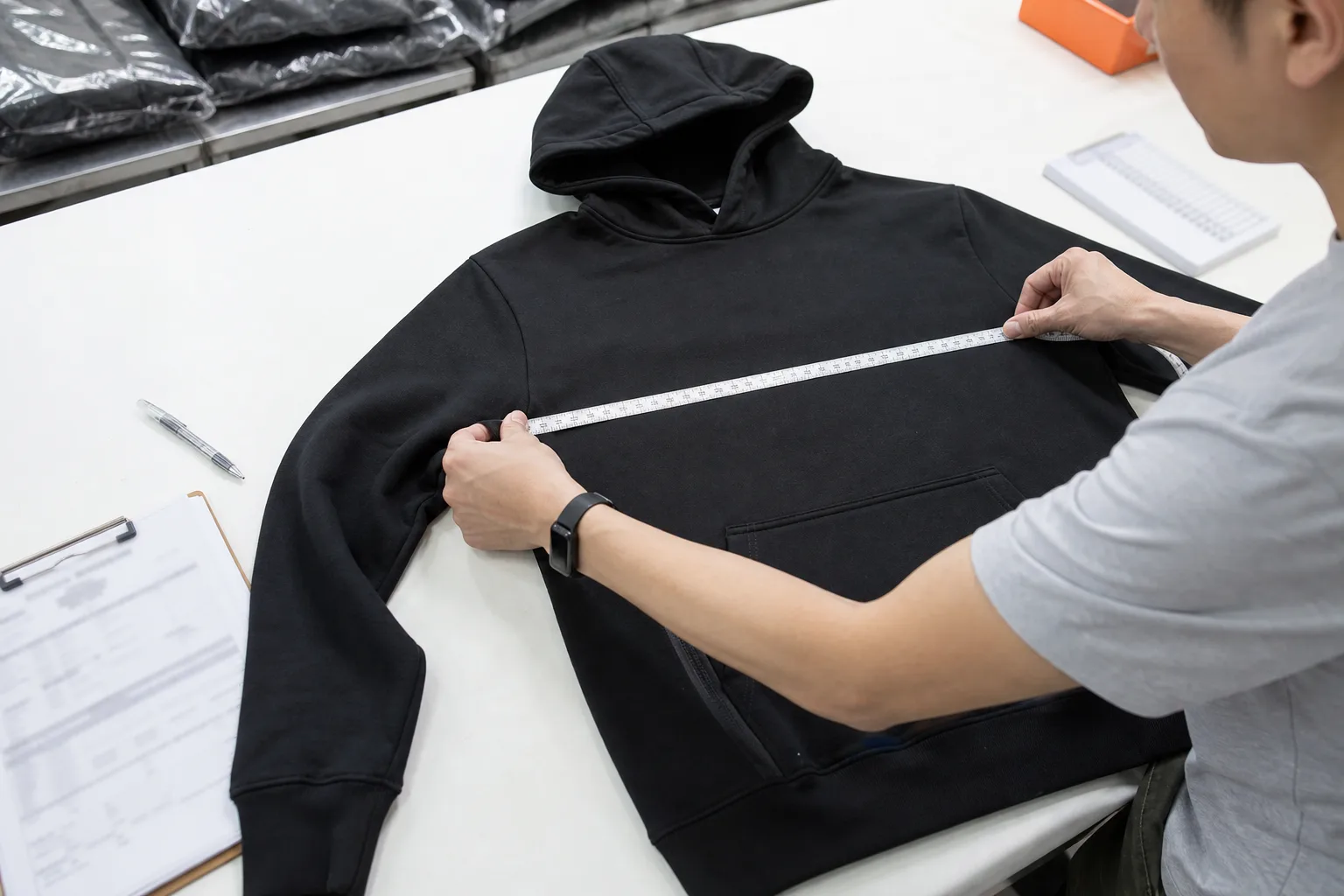
Review fit, construction, colour, decoration, labels and finishing. Photograph issues, measure the sample and send one consolidated revision. Wear and wash tests can reveal shrinkage, print or seam issues.
Approve the final specification before bulk. SHENGDE targets samples within 15 days after specifications and materials are confirmed, while complex development may require more rounds.
Launch to produce learning
Calculate landed cost, margin, marketing, returns and cash required for a repeat. Prepare photography, size guidance, care and delivery communication before stock arrives.
Track sell-through by style, colour and size alongside returns and comments. Use first-run evidence to refine grading, quantities and materials.
Scale through controlled repetition
Repeat proven patterns and materials where possible. Stable specifications improve consistency and capacity planning. Add complexity only for a commercial reason.
Maintain approved samples, fabric references, artwork, inspection records and revision history. A repeat order should begin from controlled records, not old chat messages.
Budget around landed cost, not only unit cost
Your first production budget should include sample fees, bulk cost, labels, packaging, freight, duty, payment fees, product photography, returns and reserve stock. A low factory price can still become an expensive launch if shipping, sizing or defect risk is ignored.
For a small brand, a controlled first run is often healthier than a large speculative order. The first order should create product proof, size data and customer feedback that makes the second order better.
Use production data after launch
Track sell-through by style, size and colour. Track return reasons, fit comments, wash comments and customer photos. These are not just marketing signals; they are production signals for grading, fabric, construction and quality control.
When you reorder, send the approved sample reference, change list, revised quantity split and target delivery date. A stable repeat gives the factory a clearer path to protect consistency.
Ten-step streetwear launch roadmap
| Step | Action | Output |
|---|---|---|
| 1 | Define customer | Brand brief |
| 2 | Research products | Product direction |
| 3 | Choose capsule | Style plan |
| 4 | Set budget and quantity | Commercial limits |
| 5 | Create tech packs | Production specification |
| 6 | Source materials | Material approval |
| 7 | Develop samples | Fit reference |
| 8 | Approve bulk standard | Production release |
| 9 | Prepare launch and logistics | Assets and delivery |
| 10 | Measure and repeat | Reorder plan |
Frequently asked questions
How many products should I launch?
A focused capsule is easier to develop and learn from than a broad range.
Can I launch with 50 pieces?
Some programs can start from 50 units when fabric, colour and decoration are practical.
Do I need a tech pack?
Yes, or an equivalent controlled specification that protects sampling and repeat production.